
with Leigh Ann Yoder Introducing the Airhead 2000!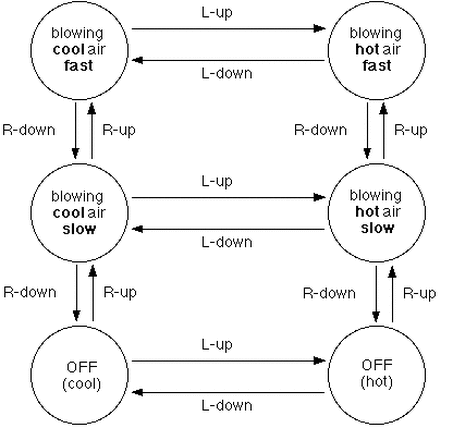 {Homework Solution} Airhead 2000 finite state diagram {Homework Solution} Airhead 2000 finite state diagram This week’s class was probably the most challenging of the semester. We continued our study of Finite State Machines, also known as Finite State Automatons – FSM or FSA for short. First, we tackled the Airhead 2000 homework by drawing out the FSM together. Some of the students struggled with the homework, but I believe most understood after we reviewed. Next, I pushed the students beyond their comfort level by illustrating two FSM’s. One was used to add two binary numbers, and the other was a parity checker. The purpose was to cycle back on topics we covered in the beginning of the semester, but now focusing on how the computer is actually instructed by the programmer. After those mind-boggling examples, we took a break by officially defining an FSM and went on a virtual treasure hunt. The students were pirates and had to take imaginary boats between islands. They were successful when they found the shortest route to Treasure Island. When the students completed the activity they realized they had created another FSM. With a firm understanding of FSM’s we discussed their applications in Computer Science, specifically in the following areas: the lexical analysis part of the compiler, text editing, computer networks, and string searching within a word processor. Finally, we had a brief discussion on artificial intelligence and how a computer can appear to understand and respond appropriately. Think Siri. We covered a lot of material! The students should be proud of themselves. Grasping the concept of an FSM at such a young age is truly an achievement! I wish all of my students and their families a blessed holiday.
with Michelle Cameron Holiday Fun Today being the last day before the holiday break, we had some fun with our writing. First, riffing off The Nightmare Before Christmas, everyone was given a Christmas character – from well-known ones such as Santa Class to less-known (and frankly imaginary) ones, such as the Candy Cane Kid and Lenny the List Maker. Then we combined them with other holiday characters, such as the Easter Bunny or the Valley Girl Valentine. While almost no one finished their stories, we had some great starts. I hope some of the kids will finish these off over the break – but they don’t have to. 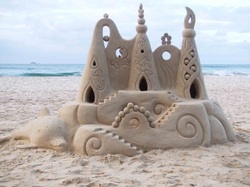 After that, we played a TWC-creation – Plotfoolery, a writing board game. The kids rolled the dice to determine the order in which to start, but then they got to take a turn whenever they were finished writing a part of their stories. There are some off-beat and whacky plot twists that they landed on (including being trapped in a sand castle) and everyone had to write the number of sentences based on their roll of the dice. Again, we had some very weird and wonderful (and to borrow their phrase, random) stories that emerged. Journal Submissions and End-of-Session ReadingsWith the holidays up and coming, homework is light. I returned most of their submissions for the online journal. Those that I didn’t will be returned via email by next Wednesday. I ask that they make the editorial changes by 12/23, so I can got our online journal up and running by the time we get back. In addition, they should decide what they want to read for our end-of-session reading. Rules: up to four double-spaced pages or three poems. It does not need to be what they submitted to the journal, although it can be. And please do let me know if you plan to attend the reading – family welcome!  Happy holidays, everyone! with Sally Zeiner December 2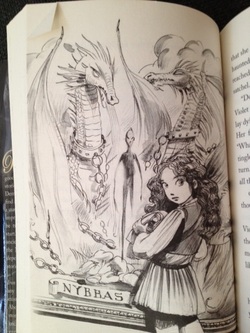 Iron Hearted Violet Iron Hearted Violet In class on December 2, we began by discussing the prior week's homework -- refining our criteria for friendship. For most of our philosophy students, a friend is someone whom you enjoy being with. Aristotle proposed that for someone to be your friend, the feelings should be mutual. He also defined three types of friendship: use, fun, and moral guidance. Our students agreed that friendship should be mutual. We also considered the Little Prince's friendship with the flower, and his reasons for leaving the planet. Has your child ever felt that they could not be friends with someone who lied or misrepresented themselves, as the little flower did to the Prince? The adventures the Little Prince had as he traveled from planet to planet raised interesting questions, especially about authority and ownership. The king says he rules over everything, but does he have any real authority? What is real authority? Where does it come from? We talked about authority in the contexts the students are most familiar with: a parent's authority, teacher's authority, and coach's authority. Our philosophy students determined that authority can come from the responsibility to take care of someone, or by voting, or through force. The businessman says that the stars belong to him. In class, we began a chart comparing and contrasting the authority and ownership of the king and the businessman with that of the Little Prince. In two weeks, we will begin discussing our final book for the course, Iron Hearted Violet. This is a long book. I highly recommend it as a family read-aloud, or even on audio, for students who may find the book challenging. As we have done all semester, we will begin class each week by working on a simple story map to make sure that we all understand the reading before we begin our discussions. December 9 From "The Little Prince" From "The Little Prince" We began class by discussing our homework from last week, comparing and contrasting the Little Prince’s concept of authority and ownership with that of the king and the businessman. As we talked, it became clear that we needed to clarify the difference between authority and ownership. We applied this to our own lives, where we can understand it best, in relation to our ownership and responsibilities for the animals in our families. We can own and take care of pets, such as chickens or cats, without having any authority over them. However, for Ava, who is raising a seeing-eye puppy, it is very important that she does have authority over him.
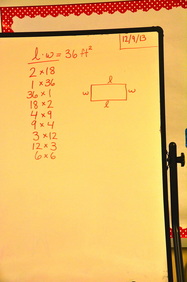
We connected this to the story of the Little Prince. One student suggested that it was as if the flower had authority over the prince, even though the prince took care of the flower. In Chapter 20 (XX), the Little Prince encounters a flower just like his. The Little Prince says, “I thought I was rich…; and all I had was a common rose.” We considered the relationship between beauty and friendship. Can we find someone or something more or less beautiful if we know them better? What is the relationship between friendship and responsibility? We will continue to explore the themes of beauty, authority, and friendship as we read Iron Hearted Violet. In class I asked students to read the first five chapters of Iron Hearted Violet for next week, and then write a paragraph or more answering the following question: How does the friendship between Violet and Demetrius compare to your criteria for friendship? Have a great week! with Kim Rodgers Area and Perimeter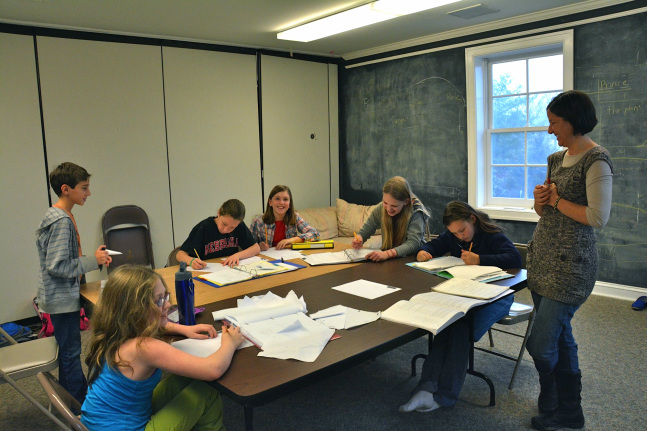 On Monday we talked about using algebra in the real world. Many students had thought about it during the week. One even had a list of professions which use algebra that was a page long! Professor Arbegla had been talking about this topic with her students in the college class she teaches, when she realized that algebra was used when she remodeled her bathroom. She was planning on tiling the bathroom floor. She knew the dimensions of the floor (6’ x 7’) and was ready to pick out tiles. Since they were so expensive, she wanted to have an idea of how many tiles she should purchase before going to the store. That’s where our class came in. Each tile was one foot square. The students spent some time figuring out how she could know how many to buy. Some drew pictures. Some knew intuitively that multiplying the number of rows by the number of columns would give us the number of tiles. We discussed why multiplying works and how finding the area of the room could help her with her project. We assigned the letter “l” for length and “w” for width and came up with a rule for area to put on our toolkit. l x w = area 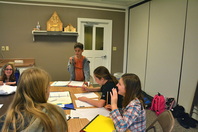 We also talked about the terms we use when discussing area. In this specific case each tile is a foot square so we call that square feet. We contrasted that with perimeter. Perimeter is a linear measurement, so we just use “feet” as the measurement. The students came up with a few ways to express perimeter:
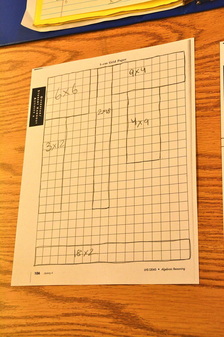
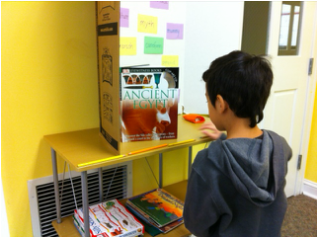
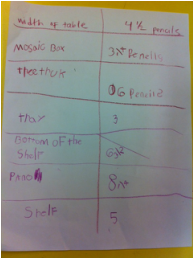
Next week we continue discussing area and planning spaces to be used for particular purposes. How does its purpose affect how we lay out the area of the enclosure? What’s the best set up for the enclosure? Some students were interested in pursuing the area of triangles and circles, so they decided to look into that for homework to share with the class next week. I look forward to letting them teach the class a thing or two! Ka and Ba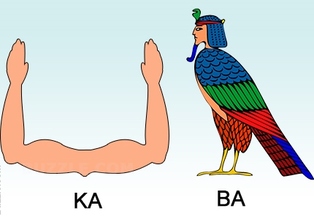 Today in class we discussed the ancient Egytian belief in two distinct parts of a person. The ka or "spirit" comes into existence when a person is born; crafted by the god Khnum on his potter's wheel. A persons ka was thought to live on after their body had died, alongside the mummy in the tomb. Offerings of food and drink were sometimes left at the entrance to the tomb so the ka could continue to eat and drink in the afterlife. The ba on the other hand, is essentially your "personality". It's what makes you - You! The ancient Egyptians believed that the ba, symbolized as a bird, would fly around and make itself useful during the day and at night would return to the tomb, looking for the mummy to which it belonged. I asked the students to take a few minutes and think about what makes them unique. What qualities define who you are? We discussed whether or not there is anyone else in the world exactly like them. I then asked them to write a word, a sentence, or a list to express who they are. Many students began by giving physical characteristics - hair color, age, gender. Then they moved on to listing what they like (cats, dogs, food) or like to do (play soccer, baseball, run, camp). We dug a little deeper when I asked them if they thought what they looked like or what they did is really who they are. Hmmm... a deep philosophical question even for adults! We took some of the examples of what they like to do (play the violin) and turned them in to qualities about ourselves (I am musical). Suddenly, many more qualities came to mind (sporty, playful, kind, curious, helpful, funny, awesome!). Wrapping up Mummy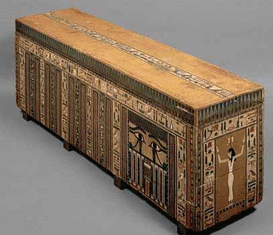 Students spent the remainder of the period working to complete their mummies, canopic jars, and sarcophagi. They painted gold masks on the plaster mummies they had prepared several weeks ago and continued to craft and paint their canopic jars. Those that had completed a mummy began to prepare a sarcophagus which we will decorate and fill next week to conclude our unit on mummies. Because we are making our sarcophagi out of shoe boxes, they will really look more like rectangular tombs or coffins. Next week we will add hieroglyphics, images of gods and goddesses, egyptian eyes, and any other decorations the students would like. Homework! Trinkets and treasures: Please have your student bring in any small treasures they would like to place in their sarcophagus, such as coins, buttons, small plastic or stuffed animal, toy food or utensils, etc. Word search: Last call for any student that wants to complete the word search and bring it to class for a small prize. Here is the file to download and print in case you did not pick one up in class. Enjoy the snow! See you all next week! Measuring Like Ancient Egyptians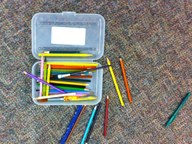 What do Pharoahs and pencils have in common? Neither one make a very good unit of measurement! The ancient Egyptian cubit was a measurement based on the distance from the Pharoah's elbow to his fingertips.
with Leigh Ann Yoder Message Routing and Third Unit {Representing Procedures}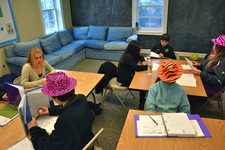 We wrapped up our unit on Algorithms today with a game focused on Message Routing. The students were modeled as the Internet and acted both as computers and routers within their own local networks. Their goal was to simulate sending and delivering messages. They discovered that without an algorithm this task is harder than it appears! Next, we began our third unit, Telling Computers What to Do – Representing Procedures. Now that we have a solid understanding of algorithms and can even put them into words, we will focus on giving the right instructions to the computers. The students will shortly discover that it is not as easy as it sounds! Finite State MachineToday we used a variety of games to introduce a simple but powerful tool called a finite state machine. The finite state machine is not really a mechanical entity, but an abstract set of instructions, which a computer can be programmed to follow precisely. The goal was to teach the students to model the behavior of common items and situations using this tool. This concept is one that is taught in college level courses and sometimes not until graduate level. Hopefully, by using a variety of hands-on activities and instruction all the students will acquire a general understanding. We will continue this topic for at least one more class.
Revision & Homeworkwith Michelle Cameron  This was our last week of revising each other’s work. We discussed what it means to be critical – not mean or nasty, but constructive. I think they have learned to be more insightful when it comes to what works and doesn’t in a work. They themselves noted that each other’s work is improving, which is an excellent sign. These were all pieces they plan to submit. This week’s homework is to revise everything they plan to submit to the online journal and to email it to me (or to send me a Google Docs link) by 12/16. I’ll review everything and we’ll talk about final changes when we’re back after the break. Here is what everyone is planning on submitting:
I also mentioned that the students should start thinking about what they want to read on the last day of class. We’ll be doing some practice after the break. Music: Frozen River Flows & Drop a Red Wagon We wrote to a piece of music today – an instrumental piece called Frozen River Flows. I found it interesting that some of the kids found it difficult to get started, while others wrote some evocative (and some depressing) pieces.
Because of the difficulty in just letting go and writing, I did an exercise in loosening the creative muscles called “Drop a Red Wagon.” It’s one of my favorites, where everyone is supposed to start off with the same sentence ― “The ice crunched under his feet” ― and then not lift the pencil or pen, no matter what they write. As they do, I tell them to drop certain objects into their writing. This time it was:
While the main objective is to write without judging the work, some of the kids were able to make sense out of these random phrases. The results were comic, of course. 11/25/13 with Kim Rodgers Writing GamesThis week Mrs. Besjak was on vacation, so I got a little taste of what life is like in the youngest class at Mosaic! We played some games from a book called, appropriately, Games for Writing. As students arrived there were blank papers separated into four sections waiting for them on the table. They were to draw four things they wanted me to know about them with words describing the pictures. If they had trouble writing they were to use the other kids at the table to help them. When they were finished they put them upside-down in a pile so I couldn’t see which one was theirs. When the class finished I grabbed the papers and we gathered in a circle on the floor. I shared each one with the class, trying to guess whose it was. We had a great time, as they laughed at me while I was trying to figure it out! 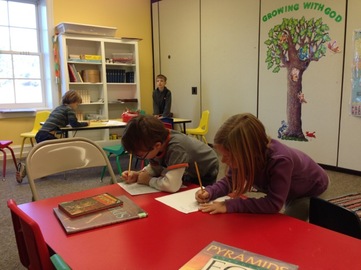 The next game we played was called A Race of Words. It was the class versus me. They had 10 minutes to walk around the room writing down or drawing a picture of everything they could see. They could do it in pairs or on their own, making sure they didn’t write about the same area as another student since they were getting points for each new item on their list. After 5 minutes I started my list. Since I had been a writer longer than them I got less time to write. When the time was up we gathered together to share our lists. I got one point for each item on my list. They got one point for each item they had on their list that I also had on my list. After sharing my list and adding up my points, they shared any items on their list that I didn’t have. They got three points for each of those items. Needless to say, I lost…badly!!! They did a great job staying focused and making their lists quite long. I didn’t have a chance!! 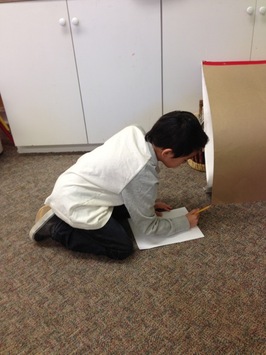 We finished up class by playing a game called Make a List. Together we created a list of ways we could thank a witch who agreed to teach us a magic spell. Sweep her cave. Buy her a cat. Pick herbs for her medicines. The students were then given a new task and asked to make a list. I had them imagine what it would be like if they took a rocket trip through the galaxy. They would be alone in space for an entire year. After the essential equipment was loaded on the ship, what extra items would they pack? The kids went to town writing down a flurry of ideas of things they would bring: iPads, pet dogs, spacedog suits, boxes of chocolate, and more! Some students needed help sounding out the words, but ALL the students had items they would bring along! I had a great time with the class and look forward to seeing them more often next semester! Simple Machines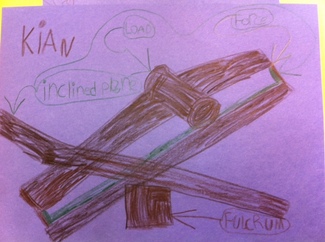 The ancient Egyptians used simple machines to build the pyramids and irrigate their fields. Today we learned about two simple machines:
12/2/13 The First Sumerian Dictator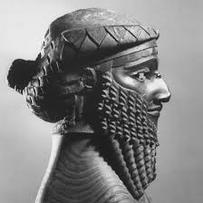 This week we read Story of the World Chapter 5 and learned about Sargon and the Akkadians. One story of Sargon tells how he floated down the Euhrates River in a basket as a baby and was found by a servant of the King of Kish. Sargon grew up inside the King's palace as one of his most trusted advisors and cup-bearers. Sargon grew to be a strong and ruthless leader, overthrowing the King and ultimately defeating all the city-states of Sumer to build an empire he called Akkadia. We used this opportunity to review some basic geography/map concepts including the four cardinal directions and how to draw a compass rose on a map. Students reviewed the geography of both Egypt and Mesopotamia that we had introduced earlier in the semester. They located the following areas on their maps:
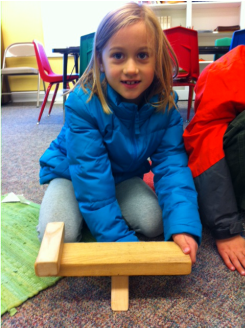
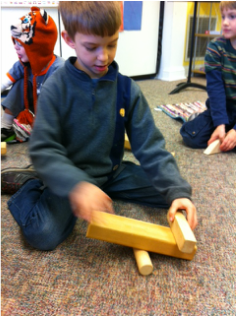
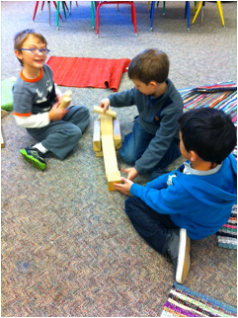
We also discussed the meaning of a military dictatorship, and how Sargon was able to force people throughout the Akkadian cities to obey his laws through use of a punishing army. We contrasted this with our own democratic system and with the way rules are structured within our own homes and agreed that a dictatorship did not seem very fair... or fun! 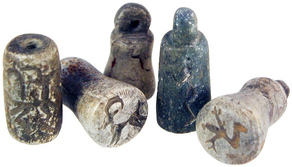 We wrapped up class by creating our own Sumerian seals, made out of air dry clay. Many Sumerian people did not know how to read or write and could not sign their name, so instead created seals or stamps with a mark that was used like a signature. Next week we will see if our seals work when we roll them through play-doh! Continuing our Design of Simple Machines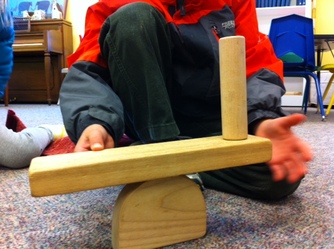 Last week we learned that the Ancient Egyptians used simple machines to help them in the work of daily living, such as the shaduf for irrigation, as well as the monumental task of building the pyramids. We also learned about levers. The lever was used in the shaduf and may have also been used to lift the heavy stones of the pyramids. As we discussed, there are many levers in use today in the world around us. There are three different types of levers, identified by the position of the effort, fulcrum, and load. Ask your child to make a lever at home, and identify the parts for you. Can they name one that we use today?
Each week students choose to continue their work with materials that we have introduced in previous weeks, according to their own interests and abilities. We continue to enjoy the Ancient Egyptian number system as well, building numbers and then translating them to the numbers that we use today. We are also learning to tell time, make papyrus, and play mancala, find ways to make 10, add up to 100, and add in the tens of thousands.
Next we week will introduce measurement, and find out how the Ancient Egyptians measured distance. Have a great week! with Michelle Cameron
Show AND Tell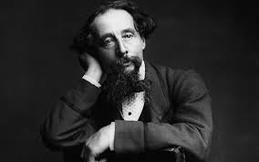 Today's topic was when to show AND tell. The famous writer’s axiom “Show, don’t tell,” is certainly useful for very important scenes – which should always be shown. But there are times when tell is a suitable writing technique – including back story, the framing of flashbacks, and certainly story transitions. We discussed what goes into a “show” scene, which includes:
We then did a number of short writing exercises to practice showing emotion on the body and face. I told them that Charles Dickens famously used a mirror to be able to show himself what emotion looked like, which he would then describe in words.  (We briefly diverted into some Dickens-related lore: how he was paid by the word, making some of his many novels quite long, as well which of his books were most famous and which he didn’t write. I’d love to suggest that, with the coming holiday season, everyone reads “A Christmas Carol” to begin to become acquainted with his writing.) So we used a mirror, having one student model sadness and another happiness. After that, we embarked on a few more layered emotions:
HomeworkNext week we’re doing our final in-class revision. I asked the kids to bring one of the pieces they’ll be submitting to our online journal – and they should work on polishing anything they wish to submit (more on that in a moment). They should bring in two double-spaced copies for revision next week. I didn’t give them any other writing to do, so please have them really focus on all of the pieces they’re going to submit. They should consult the revision guidelines I gave them early on. If you need a reminder, revisit them here: http://www.mosaicfreeschool.com/1/post/2013/09/teen-writers-circle-class-summary-93013.html. Online Journal SubmissionsWe are getting close to the end and I’d like the kids to focus on their online journal submissions. Each student can submit:
I’d really like to see more than one submission from every student. I hope everyone is enjoying the holiday season! |
Categories
All
Archives
May 2016
|





 RSS Feed